You may have lost teeth due to abscesses, gum disease, decay or trauma. If the gaps are visible this can cause unhappiness with the appearance and make you feel self-conscious and embarrassed. Other problems include difficulty chewing, altered speech and a change in the appearance of the face if the lip and cheek are more sunken.
Fortunately there are a number of options to replace missing teeth and restore your smile!
The tabs below gives a summary of the pros and cons of each option. Below that there is more detail on each treatment. Not every option will be suitable for every person and so our dentists will talk these through with you and help you choose what’s right for you.
It is important to state that none of the treatment options will last forever and all will need replacing at some point.

Pros
No action needed so no cost and no treatment time.
Cons
Teeth may drift into the gap producing difficult to clean areas or interfere when biting together.
Gap may be visible leading to cosmetic worries.
Gap may affect speech and create a lisp.
Gap may make chewing more difficult.
Sometimes it is possible to close a gap using orthodontic treatment (braces). This is usually only possible for small gaps where there are crowded teeth either side.
Pros
If other natural teeth close to the gap are crowded then they can be moved to resolve the crowding and fill the gap.
Much lower maintenance than other options.
No need for surgery or tooth shaping.
Preserves the jaw bone and maintains face shape.
Cons
Not suitable for situations where there is no crowding.
Orthodontic treatment can be high cost and takes time to complete.
Teeth can drift in position after orthodontic treatment so will need to wear some sort of retainer to keep them in the same position.
For general information about dentures click here
Pros
Lower cost than the other options below.
Can replace multiple teeth easily.
No need for surgery or shaping other natural teeth.
The pink part replaces and builds out defects in the gum where the teeth have been extracted. Can be used to increase support for the lip and to reverse the sunken lip appearance associated with ageing.
Cons
Not everyone wants teeth to be removeable.
May move when eating or speaking.
Doesn’t help preserve jaw bone where teeth have been extracted.
Traps bacteria around remaining natural teeth so can make gum disease worse and increase chances of developing decay in teeth.
May need replacing more often than fixed options.
Needs to be removed for cleaning and should be left out at night to avoid thrush infections.
Denture teeth can look very regular and not as natural as porcelain.
Depending on the design, there may be metal clips visible.
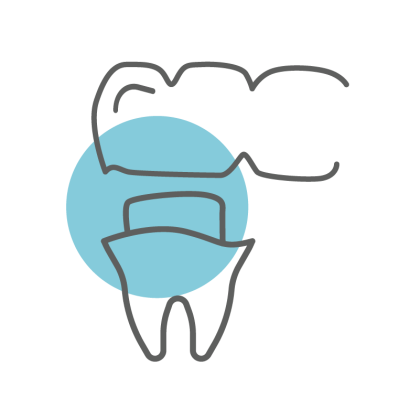
For general information about resin retained bridges click here
Pros
Fixed replacement so doesn’t have to be removed for cleaning or at night.
Minimal shaping of support teeth needed.
Good aesthetics.
Lower cost than implants and conventional bridge.
Quicker treatment time than denture or implants.
No surgery needed unlike implant treatment.
Cons
Relies entirely on the cement to keep it in place – more likely to come unstuck than a conventional bridge.
Only really suitable for a single tooth replacement and performs best when this is a front tooth.
Makes cleaning around the support teeth more difficult and so increases the chance of developing gum problems and decay in this area.
If the wing is made from metal it can make the support tooth appear grey.
For general information about bridges click here
Pros
Good aesthetics, lifelike appearance of replacement teeth.
Lower cost than implant.
Quicker treatment time than denture or implants.
Can be used to replace multiple missing teeth.
Tends to stay cemented longer than resin retained bridge.
No surgery needed unlike implant treatment.
Cons
The support teeth have to be shaped for the bridge. Taking away tooth substance during the shaping can weaken the support teeth and irritate the nerve inside the tooth. Sometimes the nerve needs removing after the shaping process, which wouldn’t have been needed otherwise.
Can make cleaning around the support tooth more difficult and increase the chances of developing decay in this tooth. So only really suitable for people who clean their teeth well and who have a low risk for dental decay.
If the bridge fails eventually due to decay around the edges, the reconstruction afterwards can be complex.
Over time the gum can recede around the support teeth which reveals the edge of the bridge. This can appear dark and be noticeable when you smile.
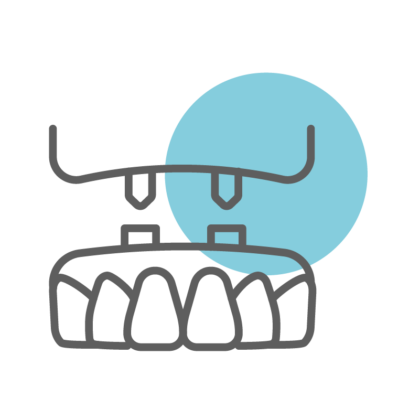
Pros
Excellent retention compared to a standard denture. This is especially noticeable for complete denture.
Process not as complicated and lower cost compared to fixed implant bridgework.
Easier to clean the implant components as the denture can be removed. Therefore is more suitable for patients who have lost their teeth due to gum disease.
Cons
Even though the retention is very good, it is still a removable denture with all the downsides as listed above.
For general information about implants click here
Pros
Fixed in place and doesn’t have to be removed for cleaning.
Excellent aesthetics.
Better long term outcomes compared to the bridge options.
No need to shape the adjacent teeth as you would for a bridge.
Keeps the jaw bone from shrinking after extraction so preserving the support for the face.
Cons
Implant treatment is a process and takes more time and has higher cost than other options.
Implants can still fail if they are not looked after properly
The screws used to hold the bridge on to the implant can become loose and need tightening or replacing so as with all dental treatment this is not “maintenance free”.
Not everyone is suitable for implant treatment. Smoking, gum disease, diabetes and other medical conditions all increase the risk of failure.
Cleaning around the implants must be excellent to remove all the plaque bacteria so not suitable for people who can’t or won’t clean well. If bacteria are left around the implant it can cause the supporting bone to shrink away and ultimately to loss of the implant.
Any surgical procedure carries risk and for implant placement this could be bruising, bleeding, pain and swelling immediately afterwards. There is also a risk of nerve damage, poor healing and infection depending on the patient and the where in the mouth the implant is placed.
All estimates given for treatment are valid for a year
See below to meet the staff who perform these procedures.